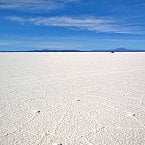
By day, it's an endless white desert, brittle as a dried crust of salt. At night, the mirror of the universe. And during the rainy season, the borders disappear completely: heaven and earth merge into one, and it seems as if you are walking not on the planet, but on the cosmos itself.
Scientists explain the origin of the Salar quite rationally: Thousands of years ago, the huge prehistoric lake Minchin was lapping here. It gradually evaporated, leaving behind a salt bottom tens of meters thick. Today it is the largest salt marsh on Earth, a geological archive of time, where each layer stores the history of the planet's climate and movement.
But the locals tell a different story.
The legend of the Tears of the Goddess
According to the ancient traditions of the Aymara people, the sacred Tunupa Mountain once stood here. She was a goddess and a mother. When her lover left her, Tunupa began to cry. Her tears mixed with the milk she was feeding the baby and flooded the valley. This is how the salt sea was born, boundless, bitter and at the same time sacred.
They say that if you look at the horizon of Salar for a long time, you can hear the echoes of her crying, quiet, almost imperceptible.
Today, Salar de Uyuni attracts not only travelers, but also scientists. Beneath its surface lies some of the largest reserves of lithium in the world, a key element for the batteries of the future. The past and the future intersect here: ancient legends and high technology.
And yet, once there, it's hard to think about the industry. Space seems to erase the boundaries of thinking. The wind sounds different. The footsteps seem louder. And the silence is deeper than anywhere else.
There are places that show the world. And there are those that change the way you look at it.
Salar de Uyuni is exactly like that.
It's not trying to impress, he's making you stop.
It doesn't explain, but asks questions.
And perhaps the main one is: where does reality end and myth begin?

Quick Search

Prices & Services
Letters from 2$
Fast Gift Delivery
2-way Video Chat
5 Membership Levels
View all rates